


What is Graphite Bearing
Graphite bearings, harnessed for their remarkable self-lubricating attributes, represent a pivotal advancement in bearing technology. Composed primarily of graphite, a form of carbon known for its natural lubrication and high thermal conductivity, these bearings mitigate friction and demonstrate exceptional thermal resilience. The inherent self-lubrication of graphite minimizes the need for external lubricants, making them particularly suitable for applications where regular maintenance is challenging. With the ability to endure high temperatures without compromising performance, graphite bearings find application in diverse industries, including automotive and aerospace. While initial costs may be higher, the reduced maintenance requirements and prolonged lifespan position graphite bearings as a cost-effective and environmentally conscious solution for reliable and efficient machinery.
Advantages of Graphite Bearing
Self-lubrication
One of the primary advantages of graphite bearings is their inherent self-lubricating property. Graphite has a natural lubrication ability, reducing the need for external lubricants. This feature minimizes friction, lowers wear and tear, and enhances the overall efficiency of the bearing.
High temperature tolerance
Graphite bearings can withstand high temperatures without losing their lubricating properties. This makes them suitable for applications in environments with elevated temperatures where traditional bearings might struggle.
Low friction
Graphite bearings exhibit low friction characteristics, contributing to improved energy efficiency and reduced heat generation. The low-friction properties help extend the lifespan of the bearing by minimizing wear.
Chemical resistance
Graphite has excellent chemical resistance, making graphite bearings suitable for applications where exposure to corrosive substances or harsh chemicals is a concern. This resistance contributes to the longevity and reliability of the bearings in challenging environments.
Versatility in design
Graphite bearings come in various forms, such as solid graphite, graphite-impregnated, and graphite composites. This versatility in design allows for customization based on specific application requirements, providing engineers with flexibility in choosing the most suitable type for their needs.





Why Choose Us
Our factory
Henan daking import and export co., ltd. Is one of china's professional production, research and development, sales of graphite mold manufacturers. The company is committed to providing customers with high quality graphite raw materials and precision graphite products processing.
Our products
Graphite mold, graphite crucible, graphite sagger, graphite plate, graphite block, graphite rod, graphite tube, graphite box, graphite electrode, diamond sintering mold, heat treatment vacuum furnace graphite accessories, photovoltaic semiconductor industry graphite parts, graphite heater for monocrystalline silicon, various special-shaped graphite accessories, etc.
Production market
Our company with high quality production process, good production environment and advanced equipment, as well as high quality products, to win the praise of customers at home and abroad,products are exported to overseas: The united states, south korea, japan, turkey, russia, pakistan and other countries and regions.
Our services
We have a perfect after-sales team to track products and provide after-sales service. We believe that customers' feedback and suggestions can make henan daking grow continuously.
Types of Graphite Bearing


Solid graphite bearings
Solid graphite bearings are composed entirely of graphite, leveraging its natural lubricating properties. These bearings are known for their self-lubrication and are suitable for applications where minimal friction and maintenance are essential.
Graphite-impregnated bearings
Graphite-impregnated bearings involve the infusion of graphite into a base material, often a metal or composite. This enhances self-lubrication while benefiting from the structural strengths of the base material, making them well-suited for applications requiring both lubricating and load-bearing capabilities.
Graphite composite bearings
Graphite composite bearings combine graphite with other materials, such as resins or fibers, creating a hybrid material with improved mechanical strength and wear resistance. These bearings are designed to withstand demanding conditions while still utilizing graphite’s lubricating properties.
Oil-impregnated graphite bearings
Oil-impregnated graphite bearings incorporate a small amount of oil along with graphite to enhance lubrication. This type is particularly useful in applications where intermittent lubrication is necessary, providing improved performance in various operating conditions.
Bushings
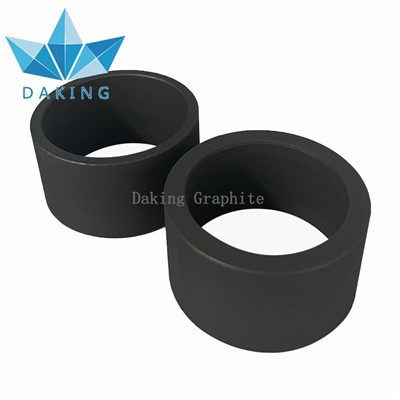
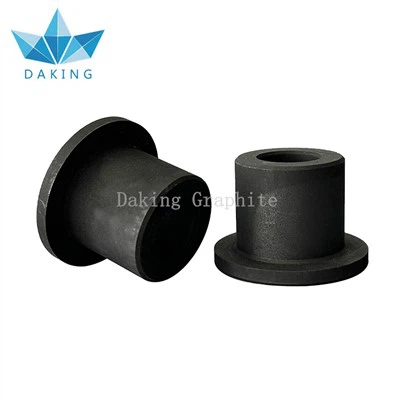
Graphite bushings are cylindrical bearings that serve as sleeves or liners. They are designed to reduce friction and wear in rotating machinery. Graphite bushings are commonly used in applications where the combination of self-lubrication and durability is crucial for efficient and reliable operation.
Choose the right carbon grade
Proper grade selection is critical when designing carbon graphite bearings, given the considerable material property differences from grade to grade that significantly impact performance. There are hundreds of different commercially available carbon grades, each of which has its own advantages and disadvantages.
For instance, a bearing submerged in water may call for a carbon graphite base impregnated with babbitt metal, whereas a dry running bearing at extreme temperatures may call for a graphitized base impregnated with an oxidation inhibitor.
Choose the right shaft material
The shaft material selection can have just as large an impact on bearing wear as the carbon grade. It is important that the shaft is as hard and smooth as possible. A harder shaft will maintain its surface finish longer than a softer one. Keeping a smooth surface finish on the shaft throughout the operating life will help to minimize wear considerably, which is why only the carbon should wear during operation.
The typical industry recommendation is a hardness of rc 35 or higher and a surface finish of 16 µ∙in or better (12 µ∙in or better for high speed applications). The corrosion resistance must also be good enough to prevent rusting or pitting which destroys the surface finish. For reference, some common shaft materials include hardened stainless steel, hastelloy, and inconel.
Avoid abrasives
Abrasives wreak havoc on carbon graphite bearings.Carbon is a soft material; on the moh’s scratch hardness scale, carbon graphite is a 2, right above talc and below silver. As a result, abrasives are able to easily score the surface of carbon graphite and accelerate wear rates significantly.
Take advantage of liquid lubrication
Having liquid inside the running clearance of a bearing can virtually eliminate bearing wear.
With sufficient fluid, impervious carbon graphite bearings can sustain a hydrodynamic film which acts as a barrier between the bearing and the shaft. This enables the bearing to withstand drastically larger pv values* than if it were dry running.
In fact, there have been instances where submerged bearings have been able to withstand pv values that are 75 times greater than what could have been achieved when running dry.
Even if the bearing is not fully submerged in liquid, splash, steam, or intermittent lubrication can be hugely beneficial when it comes to reducing wear.
Minimize the pv value
Wear is a function of the load and sliding speed over time. This can be expressed in terms of pv.
In dry running applications, carbon graphite bearings are typically able to withstand continuous exposure to a pv value of approximately 30,000 psi∙ft/min. One of the easiest ways to reduce an application’s pv value is to increase the area over which the weight is distributed. Bearing designers can do this simply by increasing the length of the bearing (without having to change any other aspect of their design).
By doubling the bearing’s length, the application’s pv value is cut in half, which increases the bearing’s operating life considerably.
Graphite Bearings Processing Features
The processing speed is quicker: Under the usual condition, the mechanical processing speed of the graphite can be 2~5 times faster than the copper; and the electric discharge machining speed is 2~3 times faster than the copper
Materials is not easy deformation, has obvious advantage in the processing of reinforced electrodes; copper softening point is 1000℃, easy deformation under heating; while graphite sublimation temperature is 3650℃. The thermal expansion coefficient of graphite is only 1/30 of copper’s.
More light weight: The density of graphite is only 1/5 of copper’. During large electrode discharge machining, it can effectively reduce the burden of machine tool (edm), more suitable for the application in large mold.
Less discharge consumption: Due to the spark machining oil also contains c atoms, in the electric discharge machining, the high heat causes decomposition of c atom from the spark machining oil, and form a protective film on the surface of the graphite electrode, to compensate for the loss of graphite electrode.
No burr: After copper electrodes processing is completed, theyt still need to be trimmed to remove the burr, while graphite processing without burr produced, saving a lot of cost, and more easy to achieve automated production.
Graphite is easier to grind and polish: Due to the cutting resistance of graphite is only 1/5 of copper’s, it is easier to carry out manual grinding and polishing.
Lower material cost,prices are more stable: Due to rising copper prices in recent years, prices of isotropic graphite is lower than the copper nowadays. Under the same volume, prices of common graphite products are 30% ~ 60% lower than the price of copper, and the price is more stable, short-term price fluctuations is very small.
Application of Graphite Bearing
Graphite bearings are used in automotive applications, such as in the suspension systems, steering columns, and other components where their self-lubricating properties and resistance to high temperatures contribute to improved performance and durability.
In aerospace applications, graphite bearings are employed in critical systems like landing gear mechanisms, control surfaces, and aircraft engines. Their ability to operate at high temperatures, low friction characteristics, and reliability make them suitable for demanding aerospace environments.
Graphite bearings are utilized in various manufacturing machinery, including those involved in metalworking, plastics processing, and textile manufacturing. Their self-lubrication reduces the need for frequent maintenance, making them ideal for continuous and high-throughput production environments.
Graphite bearings play a role in power generation equipment, such as turbines and generators. Their resistance to high temperatures, low friction, and longevity contribute to the efficiency and reliability of these critical components.
In the marine industry, graphite bearings are employed in ship propulsion systems, steering mechanisms, and other underwater applications. Their resistance to corrosion in salty environments, self-lubrication, and ability to withstand high loads make them suitable for marine conditions.
Regular inspection
Conduct routine visual inspections to detect any signs of wear, damage, or contamination. Check for irregularities in the bearing surface and address issues promptly.
Temperature monitoring
Monitor temperature variations during operation. Sudden spikes or abnormal temperature increases may indicate potential problems, and addressing them promptly can prevent excessive wear.
Lubrication management
While graphite bearings are self-lubricating, certain applications may require additional lubrication. Ensure that the bearings receive the appropriate amount of lubrication to maintain their efficiency and reduce friction.
Sealing mechanisms
Implement effective sealing mechanisms to prevent the ingress of contaminants. Proper seals can enhance the lifespan of graphite bearings by minimizing the risk of damage from foreign particles.
Cleaning procedures
Regularly clean the bearings to remove debris, dust, or other contaminants. Keeping the bearing surfaces clean contributes to smoother operation and reduces the risk of premature wear.
Future Trends in Graphite Bearing Technology
Innovations in material science
In recent years, innovations in graphite bearing material science have propelled the capabilities of these essential components. Researchers have delved into enhancing the composite structures of graphite bearings, combining them with advanced materials like carbon fibers, polymers, or metal matrices. This approach aims to bolster mechanical strength, wear resistance, and overall durability while preserving the self-lubricating characteristics of graphite. Additionally, advancements in the fabrication processes have allowed for more precise control over the microstructure of graphite bearings, optimizing their performance in specific applications. These innovations address challenges such as load capacity and extended service life, expanding the scope of graphite bearings in diverse industries. The continuous exploration of novel formulations and manufacturing techniques underscores the ongoing evolution of graphite bearing material science, driving improvements in efficiency, reliability, and sustainability.
Sustainable manufacturing practices
The future development trend of graphite bearing environmental protection technology is poised to witness a dynamic evolution as industries prioritize sustainable practices. Anticipated advancements include further refinement of manufacturing processes to reduce environmental impact and energy consumption. Innovations in material science may lead to the development of eco-friendly composite materials, enhancing the mechanical properties of graphite bearings while maintaining their self-lubricating nature. Integration of smart technologies, such as sensor-equipped bearings for real-time monitoring, could optimize maintenance practices, minimizing resource usage. Additionally, a continued focus on recycling and end-of-life strategies for graphite bearings is likely, promoting a circular economy. As industries globally intensify efforts towards environmental responsibility, the trajectory of graphite bearing technology is expected to align with eco-conscious principles, fostering a more sustainable future for machinery and industrial applications.
Comparison with Other Bearing Materials
Graphite vs. Traditional metal bearings
Graphite bearings present a compelling alternative to traditional metal bearings, showcasing distinct advantages. Unlike metal bearings that often require external lubrication, graphite bearings possess inherent self-lubricating properties, reducing the need for additional maintenance and minimizing friction. The self-lubricating nature of graphite not only enhances operational efficiency but also contributes to prolonged bearing life. Additionally, graphite’s high-temperature tolerance surpasses that of many traditional metals, making graphite bearings suitable for applications in elevated temperature environments. While metal bearings may be susceptible to corrosion, graphite’s chemical resistance adds a layer of durability in corrosive conditions. However, it’s essential to note that graphite bearings might face challenges in extremely high-load scenarios, necessitating careful consideration of application requirements. Ultimately, the choice between graphite and traditional metal bearings depends on specific performance demands, environmental conditions, and maintenance preferences.
Graphite vs. Ceramic bearings
Graphite bearings and ceramic bearings, while both offering unique advantages, cater to distinct sets of applications in the realm of industrial bearings. Graphite bearings stand out for their self-lubricating properties, reducing the reliance on external lubrication and excelling in scenarios where traditional lubrication proves challenging. With commendable high-temperature tolerance and corrosion resistance, graphite bearings find their niche in demanding environments. On the other hand, ceramic bearings, known for exceptional hardness and low friction coefficients, typically require less external lubrication than traditional metal bearings. The self-lubricating nature of ceramics, coupled with their ability to withstand high speeds and reduce wear, positions them favorably in applications where minimal friction and prolonged lifespan are critical. However, ceramics may be more susceptible to impact damage due to their inherent brittleness. The choice between graphite and ceramic bearings hinges on factors like load conditions, speed, temperature, and specific application requirements, with both materials presenting valuable solutions tailored to diverse industrial needs.
Henan Daking Import and Export Co., Ltd. (Henan Daking for short) is one of China's professional production, research and development, sales of graphite mold manufacturers. The company is committed to providing customers with high quality graphite raw materials and precision graphite products processing. The raw materials used by our company, such as isostatic pressed graphite, molded graphite and EDM graphite, have the characteristics of high strength, good thermal shock resistance, high temperature resistance, corrosion resistance and strong oxidation resistance.


FAQ
We're professional graphite bearing manufacturers and suppliers in China, specialized in providing high quality customized service. We warmly welcome you to buy high-grade graphite bearing made in China here from our factory.
Graphite Bushing Bearing, Carbon Graphite Bearing, Graphite Sleeve Bearing