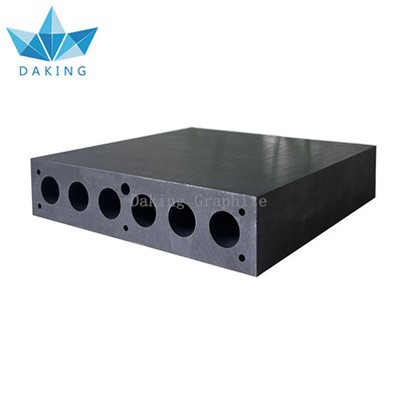
How are graphite blocks made
Leave a message
How are graphite blocks made?
Isostatically pressed high-purity graphite blocks are a high-end graphite material used in semiconductors, photovoltaics, aerospace, and other fields. Their core characteristics are "high purity" and "isotropy."
The production of isostatically pressed high-purity graphite blocks is a complex process that integrates physics, chemistry, and precision engineering. It can be divided into the following core steps:
Step 1: Raw Material Preparation and Processing
1. Selection: Petroleum coke or pitch coke is used as the primary raw material, as it has a high carbon content and low impurities. It is first calcined at high temperature (approximately 1300°C) to remove volatiles and moisture, thereby increasing its true density and chemical stability.
2. Crushing and Classification: The calcined coke is crushed and ground using equipment such as jaw crushers and Raymond mills to produce powders of varying particle sizes. A strategically balanced mix of large, medium, and small particle sizes is key to achieving a high-density green body structure. Small particles fill the gaps between larger particles, laying the foundation for subsequent high-density products. 3. Purification: To achieve "high purity" requirements (typically ash content below 50 ppm, or even 5 ppm), the aggregate powder is acid-washed (using hydrochloric acid, hydrofluoric acid, etc.) or subjected to high-temperature chlorination to effectively remove metallic impurities.
Step 2: Mixing and Molding (Core Step)
1. Binder Addition: The graded aggregate powder is mixed with a binder (usually medium- or high-temperature coal tar) while heated. The purpose of mixing is to evenly coat the surface of each aggregate particle with the tar, forming a plastic paste.
2. Isostatic Pressing: This is the key to achieving "isotropic" graphite blocks. The paste is placed in an elastic rubber mold, sealed, and then placed in a high-pressure isostatic press filled with hydraulic oil (or water). A high-pressure pump applies uniform pressure (typically 100-200 MPa) to the liquid. Because the liquid pressure is equal in all directions, the paste is uniformly compressed in all dimensions, resulting in a disordered arrangement of the internal particles, eliminating the particle orientation caused by conventional pressing. The result is a green body with a uniform structure and consistent density.
Step 3: Calcination
The formed green body is placed in a calciner and slowly heated to approximately 1000°C under a protective atmosphere (either with coke powder or an inert gas). During this process, the binder pitch undergoes complex decomposition and polymerization reactions, transforming into a strong pitch coke, which firmly binds the aggregate particles together and transforms the green body into a carbon body with high mechanical strength.
Step 4: Graphitization
This is the core process that imparts graphite properties to the material. The calcined carbon body is placed in an Acheson furnace or an internally heated tandem graphitization furnace under an inert gas atmosphere, directly heating it to temperatures of 2000-3000°C. At these extreme temperatures, the disordered "turbostratic" carbon atoms within the carbon material rearrange themselves, forming a regular, three-dimensional graphite crystal structure. This process significantly improves the material's electrical and thermal conductivity, thermal shock resistance, and chemical stability, and further volatilizes most residual impurities, achieving the ultimate ultra-high purity.
Step 5: Machining and Quality Inspection
After graphitization, the blanks are turned, milled, planed, and ground using high-precision CNC machine tools according to customer drawings, ultimately producing dimensionally precise isostatically pressed high-purity graphite products. Before shipment, they undergo rigorous testing for density, hardness, resistivity, ash content, and flexural strength.
In summary, the exceptional properties of isostatically pressed high-purity graphite blocks-high purity, high density, isotropy, and excellent thermal and electrical properties-are achieved through a meticulously controlled process chain: "raw material refinement → isotropic isostatic pressing → high-temperature calcination and curing → ultra-high-temperature graphitization and crystallization." Isostatic pressing ensures structural uniformity, while high-temperature graphitization determines the ultimate physical and chemical properties.

About US