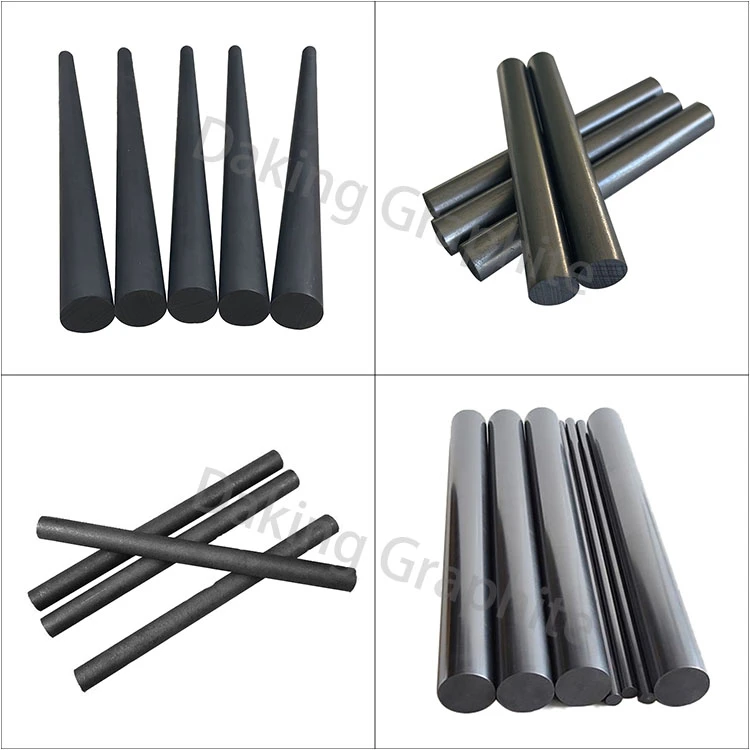
Are carbon rods better than graphite
Leave a message
Are carbon rods better than graphite?
The choice between carbon rods and graphite rods depends primarily on the specific application. If extremely high electrical and thermal conductivity, high-temperature resistance, and chemical inertness are required, and the budget allows, graphite rods are the preferred choice. However, if the application doesn't require extreme performance, the budget is limited, or high mechanical strength is required, carbon rods are a cost-effective option.
Both carbon rods and graphite rods are composed of carbon, but their structures and production processes differ, leading to differences in their properties and application scenarios. Simply put, graphite rods are an upgraded version of carbon rods that undergo high-temperature graphitization. Carbon rods are typically made by pressing and calcining a mixture of carbon black, coke, and other raw materials, resulting in a relatively disordered arrangement of carbon atoms. Graphite rods, on the other hand, require heat treatment at temperatures of 2000°C to form a regular layered crystal structure.
In terms of physical properties, graphite rods are superior to carbon rods in many respects. For example: 1. Electrical conductivity: Graphite rods offer far superior electrical and thermal conductivity to loose carbon rods. 2. High-temperature resistance: Graphite rods can withstand temperatures exceeding 3000°C, and their strength actually increases at high temperatures, while carbon rods are susceptible to oxidation and wear. 3. Lubricity and chemical stability: Graphite rods are inherently lubricating and highly resistant to acid and alkali corrosion. Carbon rods, on the other hand, offer lower costs, simpler manufacturing processes, higher mechanical strength, and greater resistance to impact and wear.
The distinct properties of carbon and graphite rods make them suitable for different applications. Graphite rods, due to their excellent electrical conductivity and high-temperature resistance, are the preferred material for arc furnaces, electrolytic cells, high-temperature vacuum furnace heating elements, and electrodes for electrical discharge machining (EDM). Their high purity and excellent lubricity also make them suitable for use as moderators or sealing materials in precision machinery and nuclear reactors. In contrast, carbon rods are more commonly used in applications requiring lower costs and less extreme performance requirements, such as positive electrodes for certain types of dry cell batteries, arc lighting or cutting, and as reducing agents in chemical reactions. Its high mechanical strength also makes it suitable for use in some grinding or polishing tools.