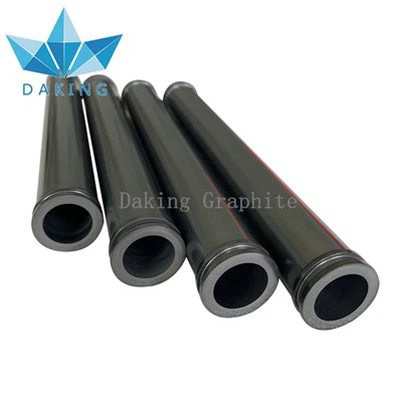
Difference Between Graphite Electrode And Graphite Rod
Leave a message
Graphite electrodes are mainly made of petroleum coke and needle coke, with coal tar pitch as a binder, and are made through calcination, batching, kneading, pressing, roasting, graphitization and mechanical processing. It is a conductor that releases electrical energy in the form of an arc to heat and melt the charge. According to its quality index, it can be divided into ordinary power, high power and super high power.
Graphite rod is a non-metallic product, and it is an essential cutting consumable before welding during the carbon arc gouging cutting process. It is made of carbon and graphite with appropriate binders, molded by extrusion, baked at 2200, and then coated with a layer of copper. It is high temperature resistant, has good electrical conductivity, and is not easy to break. Suitable for cutting metal into required shape.
Graphite rods are mainly used in various special graphite plates, graphite boats, graphite tube heaters, graphite furnace bed plates, graphite bolts, nuts, graphite brackets and graphite molds, such as vacuum resistance furnaces, induction furnaces, sintering furnaces, brazing furnaces, Ion nitriding furnace, tantalum and niobium smelting furnace, vacuum quenching furnace, etc.
Graphite rods are hard and brittle, have a small expansion coefficient, are resistant to rapid cooling and heat, are not easily deformed, have good chemical stability, strong acid resistance, do not react with strong acids, have poor alkali resistance, and can corrode and decompose rods at high temperatures. The flexural strength of the carbon rod becomes stiffer as the temperature of the component increases. According to the standard, the resistance value of the element reflected by the resistivity is measured at 25 micro-ohm-meters. The surface loading current density of the component is closely related to the raw material formula and pressing density of the black carbon rod, and can be adjusted arbitrarily according to needs.